
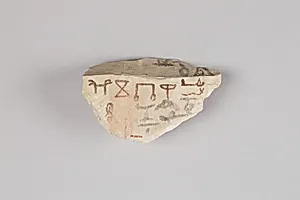
Ostracon with Workmen's Identity Marks
Unknown Artist
ca. 1390–1352 B.C.
Medium
Limestone, ink, paint
Dimensions
L. 13.8 × H. 9 × D. 4.5 cm (5 7/16 × 3 9/16 × 1 3/4 in.)
Classification
Ostracon, hieroglyphic, workmen's identity markers
Period
New Kingdom
Department
Egyptian Art
Museum
Metropolitan Museum of Art, New York, NY
Credit
Gift of Theodore M. Davis, 1909
Accession Number
09.184.700
Rights
Public Domain
Art Historical Context
Step into the bustling world of ancient Egypt with this unassuming yet revealing *Ostracon with Workmen's Identity Marks*, to around 1390–1352 B.C. during the New Kingdom's Dynasty 20–21 Crafted from a modest limestone fragment—measuring just 13.8 × 9 × 4.5 cm—this object was inscribed with ink and paint, serving as a practical notepad for laborers. Unlike grand monuments, ostraca like this were scraps reused for quick writings, offering a rare glimpse into the daily grind of ancient workers. In the hierarchical society of the New Kingdom, these identity marks were vital for tomb builders and artisans, likely from sites like Deir el-Medina, where teams constructed royal burials. The inscriptions helped track attendance, allocate tasks, or verify identities amid large-scale projects, highlighting the organized bureaucracy that powered Egypt's golden age. Techniques were simple yet effective: black ink for text and hints of color for emphasis, showcasing the resourcefulness of scribes on limestone's rough surface. Today, gifted to the Metropolitan Museum of Art by Theodore M. Davis in 1909, this ostracon bridges the elite art of pharaohs with the lives of ordinary folk. It reminds us that history thrives in the smallest details, humanizing the pyramid-builders and revealing the ink-stained hands behind Egypt's enduring legacy.