
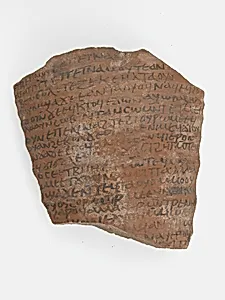
Ostrakon
Unknown Artist
7th century
Medium
Pottery fragment with ink inscription
Dimensions
4 13/16 x 4 15/16 in. (12.2 x 12.6 cm)
Classification
Ceramics
Culture
Coptic
Department
Medieval Art
Museum
Metropolitan Museum of Art, New York, NY
Credit
Rogers Fund, 1912
Accession Number
12.180.96
Rights
Public Domain
Tags
Art Historical Context
Step into the everyday world of 7th-century Coptic with this modest yet revealing *Ostrakon*, a small pottery fragment inscribed with ink. Measuring just 4 13/16 x 4 15/16 inches, this artifact from the Metropolitan Museum of Art's Medieval Art collection the ingenuity of ancient scribes who repurposed broken ceramics as affordable writing surfaces. Acquired through the Rogers Fund in 2, it exemplifies Coptic culture—a vibrant Christian tradition in late antique Egypt blending Egyptian, Greek, and Byzantine influences. Ostraka like this one were ubiquitous in daily life, serving as scraps for letters, receipts, school exercises, and personal notes. Tagged as "Correspondence," this piece likely bears a message exchanged among ordinary people, offering a rare glimpse into Coptic literacy and social connections amid the region's transition under early Islamic rule. The ink inscription, applied directly to the rough shard, highlights practical artistry over ornamentation, prioritizing function in a resource-scarce society. As a ceramic survivor from Coptic workshops, it underscores how humble materials preserved voices from the past, illuminating themes of community and communication in medieval Egypt. A testament to resilience, this ostrakon invites us to ponder the stories etched on its surface.