
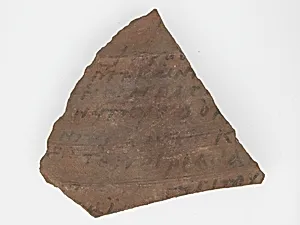
Ostrakon
Unknown Artist
7th century
Medium
Pottery fragment with ink inscription
Dimensions
3 3/8 x 3 in. (8.5 x 7.6 cm)
Classification
Ceramics
Culture
Coptic
Department
Medieval Art
Museum
Metropolitan Museum of Art, New York, NY
Credit
Rogers Fund, 1912
Accession Number
12.180.130
Rights
Public Domain
Tags
Art Historical Context
Step into the everyday world of 7th-century Coptic Egypt with this unassuming ostrakon—a small pottery fragment, just 3⅜ x 3 inches, bearing an ink inscription. Part of the Metropolitan Museum of Art's Medieval Art collection (acquired through the Rogers Fund in 1912), this shard exemplifies humble ceramics repurposed for practical use. In ancient and early medieval Egypt, broken potsherds like this were ideal writing surfaces: cheap, abundant, and durable compared to costly papyrus. Ostraka were the notebooks of antiquity, scratched or inked with everything from letters and accounts to prayers and school exercises. Tagged as "correspondence," this piece likely captures a personal message, offering a rare window into Coptic Christian life during a time of cultural transition—after the Arab conquest of 641 CE, when Egypt's native Christian communities persisted amid Islamic rule. Such artifacts reveal widespread literacy among monks, scribes, and ordinary folk. Though created by an unknown hand, its simplicity underscores the ingenuity of Coptic material culture, blending utilitarian pottery with epistolary art. A tiny survivor, it humanizes history, whispering stories from a vibrant, resilient era.