
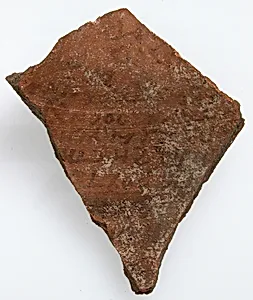
Ostrakon
Unknown Artist
600
Medium
Pottery fragment with ink inscription
Dimensions
3 5/16 x 4 7/16 in. (8.4 x 11.2 cm)
Classification
Ceramics
Culture
Coptic
Department
Medieval Art
Museum
Metropolitan Museum of Art, New York, NY
Credit
Rogers Fund, 1914
Accession Number
14.1.45
Rights
Public Domain
Tags
Art Historical Context
This unassuming ostrakon, a humble pottery fragment inscribed with ink, offers a window into the everyday world of Coptic Egypt around 600 AD. just 3 5/16 x 4 7/16 inches, it exemplifies the practical use of broken ceramics as affordable writing surfaces when papyrus was scarce or costly. In Coptic culture—the Christian continuation of ancient Egyptian traditions—these shards captured everything from personal letters and receipts to literary excerpts and school exercises, preserving the voices of ordinary people. Dated to the early medieval period under Byzantine influence, this artifact highlights the Coptic language's role as the final evolution of ancient Egyptian, written in a Greek-derived script. Housed in the Metropolitan Museum of Art's Medieval Art Department (acquired via the Rogers Fund in 1914), it underscores ceramics' dual role as both utilitarian objects and historical documents. Unlike grand monuments, ostraka reveal intimate details of daily life, commerce, and faith in a vibrant Christian community navigating cultural shifts. Though the exact inscription remains unspecified, such fragments are treasures for scholars, illuminating literacy, administration, and religious practices in late antique Egypt. A testament to resourcefulness, this piece invites us to appreciate the artistry in survival.