
Ostrakon
Unknown Artist
600
Medium
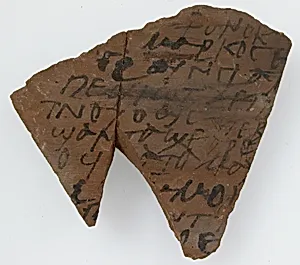
Pottery fragment with ink inscription
Dimensions
3 3/8 x 3 7/8 in. (8.5 x 9.8 cm)
Classification
Ceramics
Culture
Coptic
Department
Medieval Art
Museum
Metropolitan Museum of Art, New York, NY
Credit
Rogers Fund, 1914
Accession Number
14.1.60
Rights
Public Domain
Tags
Art Historical Context
Step into the world of everyday ancient writing with this intriguing *Ostrakon* from around 600 AD, a humble pottery fragment inscribed with ink. Measuring just 3⅜ x 3⅞ inches, this Coptic artifact from Egypt reveals how people repurposed broken ceramics—known as ostraca—as affordable writing surfaces when papyrus was scarce. Housed in the Metropolitan Museum of Art's Medieval department, it exemplifies the practical ingenuity of Coptic culture, blending Egyptian traditions with emerging Christian influences during the late antique period. In Coptic society, under Byzantine rule transitioning toward early Islamic times, ostraca like this served as scraps for notes, letters, receipts, or even school exercises. The ink inscription, though not fully detailed here, likely captures daily life—perhaps a business transaction, prayer, or literary snippet in the Coptic script, a late evolution of ancient Egyptian hieroglyphs adapted for Christian texts. This medium highlights the democratization of literacy beyond elites, offering historians precious glimpses into vernacular language and social practices. As a ceramic "document," its cultural significance lies in preserving Coptic identity amid cultural shifts. Acquired through the Rogers Fund in 1914, it underscores how such fragments illuminate the lived religion and administration of early medieval Egypt, bridging art and history in unexpectedly intimate ways.