
Ostrakon
Unknown Artist
580–640
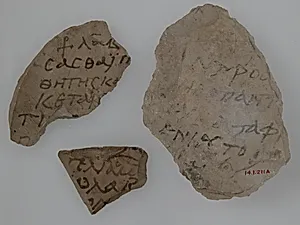
Medium
Limestone fragments with ink inscription
Dimensions
a: 3 11/16 x 2 5/8 x 13/16 in. (9.4 x 6.7 x 2.1 cm) b: 2 5/8 x 2 5/16 x 7/16 in. (6.7 x 5.8 x 1.1 cm) c: 1 5/16 x 1 3/4 x 1/16 in. (3.4 x 4.4 x 0.2 cm)
Classification
Miscellaneous-Stone
Culture
Coptic
Department
Medieval Art
Museum
Metropolitan Museum of Art, New York, NY
Credit
Rogers Fund, 1914
Accession Number
14.1.211a-c
Rights
Public Domain
Tags
Art Historical Context
This delicate *Ostrakon*, dating to 580–640 CE, consists of three limestone fragments inscribed with ink, a window into everyday life in Coptic Egypt. Produced during the late antique period under Byzantine rule, these shards—measuring just a few inches across—were writing surfaces, as papyrus was costly and scarce. The Coptic culture, blending ancient Egyptian traditions with early Christianity, repurposed broken pottery or stone like this for practical purposes, from school exercises and letters to religious texts. The ink inscriptions, likely in Greek (as suggested by associated tags), highlight the multilingual world of the time, where Greek coexisted with emerging Coptic script. Ostraca like these were ubiquitous in monastic and urban settings, preserving fragments of literature, accounts, or prayers that might otherwise be lost. Their survival underscores the resourcefulness of Coptic scribes. Housed in the Metropolitan Museum of Art's Medieval Art department (Rogers Fund, 1914), this artifact reveals the artistry in simplicity: precise ink strokes on irregular stone evoke the tactile world of ancient literacy. For visitors, it humanizes a vibrant Christian society on the cusp of Islamic Egypt, bridging pagan past and medieval future.