
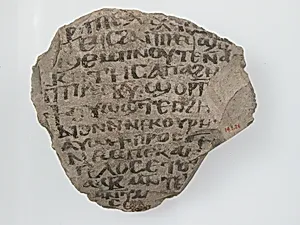
Ostrakon with a Letter from Jonah to Elias
Unknown Artist
600
Medium
Limestone with ink inscription
Dimensions
4 3/4 x 4 5/16 in. (12 x 11 cm)
Classification
Ceramics
Culture
Coptic
Department
Medieval Art
Museum
Metropolitan Museum of Art, New York, NY
Credit
Rogers Fund, 1914
Accession Number
14.1.26
Rights
Public Domain
Art Historical Context
In the bustling world of 7th-century Coptic Egypt, everyday writing often unfolded on humble ostraka—fragments of limestone or pottery reused as affordable scraps when papyrus was scarce. small limestone piece (just 4¾ x 4⅜ inches), inscribed with ink around 600 CE, exemplifies that practice. Bearing a personal letter from Jonah to Elias, offers a rare, intimate window into Coptic daily life during the early medieval period, when Christianity flourished under Byzantine and later Islamic rule. The inscription, executed in Coptic script, highlights the culture's linguistic evolution—a blend of Greek, Demotic, and emerging Arabic influences—used for everything from religious texts to correspondence. Though classified among ceramics due to the era's common use of sherds, this limestone ostrakon underscores resourcefulness in a society where literacy bridged personal bonds and spiritual devotion. Jonah and Elias, evocative biblical names, suggest a Christian context, perhaps reflecting familial or communal ties. Acquired through the Rogers Fund in 1914 and housed in the Metropolitan Museum of Art's Medieval Art department, this artifact captivates with its simplicity. It reminds us that history's grand narratives often hide in such unassuming scraps, preserving voices from Coptic Egypt's vibrant past.