
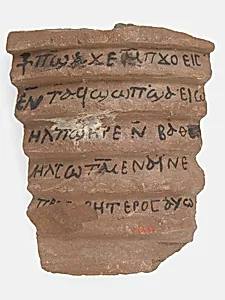
Ostrakon with Biblical Text
Unknown Artist
600
Medium
Pottery fragment with ink inscription
Dimensions
3 7/8 x 4 3/4 in. (9.8 x 12 cm)
Classification
Ceramics
Culture
Coptic
Department
Medieval Art
Museum
Metropolitan Museum of Art, New York, NY
Credit
Rogers Fund, 1914
Accession Number
14.1.83
Rights
Public Domain
Tags
Art Historical Context
This modest ostrakon, a pottery fragment inscribed with ink, offers a fascinating glimpse into everyday life in 6th-century Coptic Egypt. Dating to around 600 AD, it measures just 3 7/8 x 4 7/4 inches and bears Biblical text in the Coptic script, the language of Christian Egyptians blending Greek, Demotic, and indigenous elements. Produced by an unknown artist, such shards were ubiquitous writing surfaces—affordable scraps from broken vessels reused for notes, letters, school exercises, or religious passages. In Coptic culture, thriving under Byzantine rule before the Arab conquest, ostraka like this bridged utilitarian ceramics and sacred devotion. The ink inscription technique, applied with reed pens, highlights the era's practical literacy among monks, scribes, and laity, preserving scripture amid resource scarcity. As a ceramic artifact in the Medieval Art department at The Metropolitan Museum of Art (acquired via the Rogers Fund in 1914), it exemplifies how humble objects illuminate faith's role in daily Coptic society. Today, this tiny survivor underscores the artistry in simplicity: no grand frescoes, but a testament to enduring spirituality etched on everyday pottery.