
Ottoman Court Carpet
Unknown Artist
late 16th–17th century
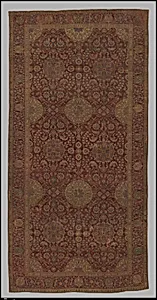
Medium
Wool (warp, weft and pile); asymmetrically knotted pile
Dimensions
Rug: Gr. L. 226 1/4 in. (574.7 cm) Gr. W. 112 in. (284.5 cm) L. of proper right: L. 223in. (566.4 cm) L. of proper left: L. 224in. (569 cm) Tube: H. 131 1/4 in. (333.4 cm) Diam. 11 in. (27.9 cm)
Classification
Textiles-Rugs
Department
Islamic Art
Museum
Metropolitan Museum of Art, New York, NY
Credit
Bequest of George Blumenthal, 1941
Accession Number
41.190.257
Rights
Public Domain
Art Historical Context
Step into the opulent world of the Ottoman Empire with this magnificent *Ottoman Court Carpet*, woven by an unknown master artisan in the late 16 to 17th century. an impressive 18 feet 10 inches long and nearly 9 feet 4 inches wide, this wool pile rug was designed for grandeur, likely gracing the halls of imperial palaces or elite residences. Its vast scale speaks to the carpet's role as a status symbol in Ottoman society, where such textiles transformed floors into canvases of luxury and power. Crafted using the asymmetrically knotted pile technique—characteristic of Turkish weaving traditions—the carpet's warp, weft, and pile are all pure wool, ensuring durability and a plush texture. This "Turkish knot" method allowed for intricate patterns and fine detail, distinguishing Ottoman court carpets from their Persian counterparts. Produced during the empire's golden age under sultans like Suleiman the Magnificent's successors, these rugs embodied Islamic artistic principles, blending geometric motifs with floral designs symbolizing paradise gardens. A treasured bequest to the Metropolitan Museum of Art in 1941 from George Blumenthal, this carpet offers a tactile glimpse into Ottoman court life. Though patterns aren't specified here, its survival highlights the enduring reverence for these masterpieces in Islamic art, inviting visitors to ponder the weavers' skill and the footsteps of history that once crossed its surface.