
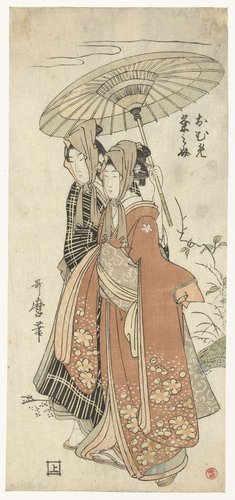
Oume Kumenosuke
1800 - 1805
Medium
color woodcut
Dimensions
325; 150
Rights
Public Domain
About this artwork
kleurenhoutsnede; lijnblok in zwart met kleurblokken
Art Historical Context
**Oume Kumenosuke is a striking color woodcut by Kitagawa Utamaro one of the masters of ukiyo-e, Japan's "pictures of the floating world" from the Edo period (1603–1868). between 1800 and 1805, near the end of Utamaro's prolific career passed away in 1806 print captures the elegance of everyday life, likely portraying a courtesan or beauty named Oume Kumenosuke Its vertical format (325mm high by 150mm wide) a *hashira-e* or pillar print, designed to hang gracefully on narrow architectural pillars in homes or teahouses, immersing viewers in the vibrant Yoshiwara pleasure district culture. Utamaro's genius shines in his bijin-ga style, celebrating feminine grace with subtle expressions and flowing robes. This work employs the classic ukiyo-e technique: a black line block (*key block*) defines precise contours, followed by multiple color blocks layered for rich hues—evident in the Dutch description "kleurenhoutsnede; lijnblok in zwart met kleurblokken" (color woodcut; black line block with color blocks). This labor-intensive process, involving carvers and printers, made such prints affordable art for the masses, democratizing beauty. Culturally, it reflects Edo Japan's fascination with transient pleasures amid strict social hierarchies. Utamaro's innovative poses and textures elevated woodcuts to high art, influencing global modernists like Whistler and Van Gogh. A window into 19th-century Japan's refined aesthetic, this intimate portrait invites us to savor its poised serenity.
About the Artist
Kitagawa Utamaro · 1753–1806
Kitagawa Utamaro (c. 1753-1806) was one of the most celebrated masters of ukiyo-e woodblock printing, revolutionizing the art of bijin-ga (pictures of beautiful women) during Japan's Edo period. Born Kitagawa Ichitaro, his early life remains shrouded in mystery, with conflicting accounts placing his birth in Kyoto, Osaka, Yoshiwara in Edo (modern Tokyo), or Kawagoe in Musashi Province. Under the t...