
Our Lady of Solitude
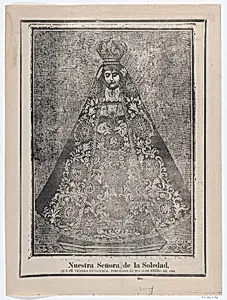
Medium
LIthographf and letterpress on buff paper
Dimensions
Sheet: 15 15/16 × 11 13/16 in. (40.5 × 30 cm)
Classification
Prints
Department
Drawings and Prints
Museum
Metropolitan Museum of Art, New York, NY
Credit
The Elisha Whittelsey Collection, The Elisha Whittelsey Fund, 1946
Accession Number
46.46.296
Rights
Public Domain
Tags
Art Historical Context
"Our Lady of Solitude" is a poignant 190 print created by the legendary Mexican artist José Guadalupe Pos in collaboration with publisher Antonio Vanegas Arroyo.ed in lithograph andpress on buff paper, this work measures 15 15/16 × 11 13/16 inches and exemplifies the vibrant broadsheet tradition of early 20th-century Mexico.ada's masterful use of lithography allowed for detailed, expressive imagery, while letterpress added bold text, making these affordable prints accessible to the masses. Depicting a solitary female figure—likely the Virgin Mary in a moment of quiet devotion—this portrait reflects deep Catholic devotion central to Mexican culture during the Porfiriato era, just before the Mexican Revolution. Posada, renowned for his satirical calaveras (skeleton motifs) and social commentary, infused religious subjects with emotional depth and folk artistry, blending European print techniques with indigenous influences. Housed in the Metropolitan Museum of Art's Drawings and Prints department, this piece from The Elisha Whittelsey Collection highlights Posada's enduring legacy. His bold lines and dramatic contrasts inspired later Mexican muralists like Diego Rivera, preserving everyday spirituality in an era of political upheaval. A timeless emblem of solitude and faith, it invites visitors to ponder the Virgin's serene gaze amid life's tempests.
About the Artist
José Guadalupe Posada|Antonio Vanegas Arroyo · 1852–1913
José Guadalupe Posada (1852-1913) was a Mexican printmaker and engraver who revolutionized popular art and created some of the most iconic images in Mexican culture. Working primarily with publisher Antonio Vanegas Arroyo, he produced over 20,000 images during his career—inexpensive broadsheets sold for a penny on colored paper that made his art accessible to even the poorest workers. He transform...