
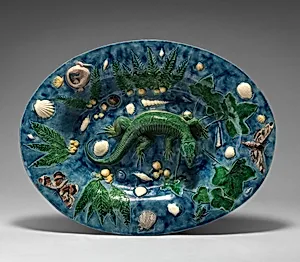
Oval basin with lizard, shells, and light blue background
1865–1875
Medium
Glazed earthenware
Dimensions
confirmed: 2 3/16 × 16 3/4 × 12 3/4 in. (5.6 × 42.5 × 32.4 cm)
Classification
Ceramics-Pottery
Culture
French, Paris
Department
European Sculpture and Decorative Arts
Museum
Metropolitan Museum of Art, New York, NY
Credit
Gift of Wallis Katz, in memory of Marshall Katz, and in celebration of the Museum's 150th anniversary, 2020
Accession Number
2020.86.10
Rights
Public Domain
Art Historical Context
This charming oval basin, crafted by artist Georges Pull in Paris between 1865 and 1875, exemplifies refined decorative arts of Second Empire France. Made of glazed earthenware—a durable, low-fired clay coated with a glossy vitreous glaze for both functionality and aesthetic appeal—the piece measures a modest 2 3/16 × 16 3/4 × 12 3/4 inches, suggesting it served as a washbasin, centerpiece, or vanity item in affluent households. Pull's work reflects Paris's vibrant ceramics scene, where artisans blended utility with ornamentation amid the era's industrial and artistic innovations. The basin's light blue background provides a serene canvas for its naturalistic motifs: a lively lizard and scattered shells, rendered with meticulous detail in the glaze. These elements evoke the exotic allure of nature, possibly drawing from contemporary interests in zoology and seaside collecting, popular among the French bourgeoisie. The oval form and vibrant palette highlight Pull's skill in majolica-style techniques, where colored glazes are layered before firing to create vivid, enamel-like effects. Now housed in the Metropolitan Museum of Art's Department of European Sculpture and Decorative Arts, this basin was generously gifted in 2020 by Wallis Katz in memory of Marshall Katz, celebrating the Museum's 150th anniversary. It offers visitors a glimpse into 19th-century French domestic elegance, where everyday objects became canvases for artistic whimsy.