
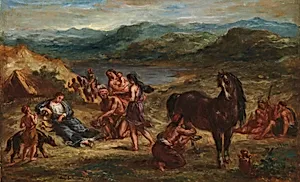
Ovid among the Scythians
1862
Medium
Oil on paper, laid down on wood
Dimensions
12 5/8 x 19 3/4 in. (32.1 x 50.2 cm)
Classification
Paintings
Department
European Paintings
Museum
Metropolitan Museum of Art, New York, NY
Credit
Wrightsman Fund, in honor of Philippe de Montebello, 2008
Accession Number
2008.101
Rights
Public Domain
Tags
Art Historical Context
Eugène Delacroix's *Ovid among the Scians* (1862) captures a dramatic moment from the life of the ancient Roman poet Ovid, who was exiled by Emperor Augustus to the wild Black Sea region of Tomis, inhabited by the nomadic Scythians. Painted in the final year of Delacroix's life, this intimate oil sketch on paper laid down on wood depicts Ovid, frail and pleading, surrounded by rugged Scythians—men, women, dogs, and horses—highlighting themes of civilization clashing with barbarism. As a cornerstone of French Romanticism, Delacroix infuses the scene with emotional intensity and exotic allure, drawing from literary sources like Ovid's own *Tristia* and *Epistulae ex Ponto*. Delacroix's mastery shines in his loose, fluid brushwork, which conveys movement and pathos even on this modest support of paper—a medium he favored for rapid studies and personal experiments. Unlike grand canvases, this 12⅝ × 19¾-inch work feels immediate and spontaneous, embodying Romanticism's emphasis on passion over classical restraint. It reflects Delacroix's lifelong fascination with history, literature, and the "Orient," influenced by his travels and Byron's poetry. Acquired by the Metropolitan Museum of Art through the Wrightsman Fund in honor of former director Philippe de Montebello, this piece offers visitors a window into Delacroix's creative process, bridging antiquity and 19th-century imagination.
About the Artist
Eugène Delacroix · 1798–1863
Eugène Delacroix (1798–1863) stands as the defining figure of French Romanticism and a pivotal bridge to modernism. Born in Charenton-Saint-Maurice near Paris, he came from distinguished lineage—his mother descended from the prestigious Oeben-Riesener furniture dynasty, while persistent speculation suggested the statesman Talleyrand may have been his biological father, a theory supported by physic...