
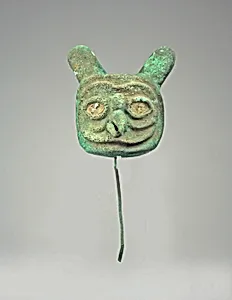
Owl Head
Unknown Artist
6th–7th century
Medium
Gilded copper
Dimensions
Height 3-3/16 in. (8 cm)
Classification
Metal-Ornaments
Culture
Moche
Department
Arts of Africa, Oceania, and the Americas
Museum
Metropolitan Museum of Art, New York, NY
Credit
Bequest of Jane Costello Goldberg, from the Collection of Arnold I. Goldberg, 1986
Accession Number
1987.394.22
Rights
Public Domain
Tags
Art Historical Context
This exquisite *Owl Head*, crafted by an unknown Moche artist between the 6th and 7th centuries, hails from the ancient Moche culture of Peru's northern coast. Standing just 3-3/16 inches (8 cm) tall, this gilded copper ornament exemplifies the Moche's mastery of metallurgy during a time when their society thrived on sophisticated irrigation, monumental architecture, and vivid artistic expressions. Likely worn as jewelry or a ritual accessory, it reflects the culture's reverence for animals as spiritual messengers. The medium—gilded copper—highlights innovative techniques like depletion gilding, where the surface copper was selectively removed to reveal a gold-rich layer, then polished to a luminous sheen. This labor-intensive process not only created durable, eye-catching pieces but also symbolized wealth and divine power in Moche society, where metalwork adorned elites and deities alike. Owls held potent symbolism in Moche iconography, often linked to the night, sorcery, or the supernatural, making this small yet striking artifact a window into their worldview. Now at the Metropolitan Museum of Art through the bequest of Jane Costello Goldberg, it invites us to ponder the enigmatic beliefs of a civilization that vanished over a millennium ago.