
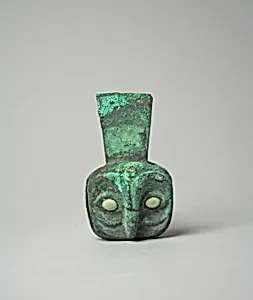
Owl Tab Ornament
Unknown Artist
6th–7th century
Medium
Silvered copper
Dimensions
Length 2-9/16 in. (6.6 cm)
Classification
Metal-Ornaments
Culture
Moche
Department
Arts of Africa, Oceania, and the Americas
Museum
Metropolitan Museum of Art, New York, NY
Credit
Bequest of Jane Costello Goldberg, from the Collection of Arnold I. Goldberg, 1986
Accession Number
1987.394.125
Rights
Public Domain
Tags
Art Historical Context
This delicate Owl Tab Ornament, crafted from silvered copper in the th–7th century, hails from the vibrant Moche culture of ancient Peru's northern coast. Measuring just 2-9/16 inches (6.6 cm) in length, this small metal adornment likely served as a decorative tab for clothing, headdresses, or ceremonial objects. The Moche, flourishing between 100–800 CE, were master metalworkers who perfected techniques likeilding and silvering over copper bases creating shimmering surfaces that mimicked precious metals. This piece exemplifies their skill in repoussiné—hammering thin sheets into intricate forms—evident in the owl's finely detailed feathers and alert posture. Owls held profound symbolic power in Moche iconography, often linked to the night, sorcery, and the supernatural realm. These birds appear frequently in Moche art, from ceramics to murals, embodying deities or sacrificial messengers bridging the human and divine worlds. As part of the Metropolitan Museum of Art's collection (bequest of Jane Costello Goldberg, 1986), this ornament offers a glimpse into Moche elite life, where such finery signaled status and spiritual connection. Today, it invites us to marvel at a civilization's ingenuity, blending artistry with cosmology in everyday splendor.