
Pa. German Plate
c. 1936
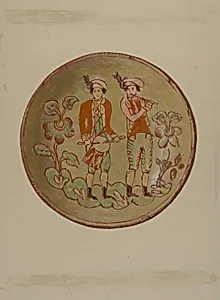
Medium
oil paint on paperboard
Dimensions
overall: 46.1 x 36.3 cm (18 1/8 x 14 5/16 in.)
Classification
Index of American Design
Department
CG-W
Museum
National Gallery of Art, Washington, D.C.
Credit
Index of American Design
Accession Number
1943.8.8001
Rights
Public Domain
Art Historical Context
This rendering of a Pennsylvania German, created around 193 by Eugene Shellady in oil paint on paperboard, belongs to the Index of American Design. This ambitious New Deal project, part of the Federal Art Project, commissioned artists to document the nation’s decorative arts and folk traditions with meticulous accuracy. The resulting collection at the National Gallery of Art preserves a visual record of everyday objects that might otherwise have been lost to time. The subject reflects the distinctive folk art of Pennsylvania German (or Pennsylvania Dutch) communities, German-speaking settlers who arrived in the 18th century. Their plates and pottery often featured lively colors, hearts, tulips, birds, and geometric patterns that blended European heritage with New World life. These pieces were both practical household items and expressions of cultural identity, showcasing skilled craftsmanship in ceramics or painted surfaces. Produced during the Great Depression, Shellady’s work highlights how government-supported art programs celebrated American ingenuity and heritage. The oil-on-paperboard technique allowed for rich, durable color that captures the original object’s charm. Today it invites visitors to appreciate how folk traditions shaped the country’s visual culture, turning ordinary plates into lasting symbols of community and creativity.
About the Artist
Eugene Shellady · 1855–present
**Eugene Shellady: Documenting American Folk Art Treasures** Eugene Shellady was an American artist active around 1935, best known for his contributions to the Index of American Design, a monumental Works Progress Administration (WPA) project under the Federal Art Project. Launched in 1935 and continuing through 1942, the Index employed some 400 artists across 34 states to create over 18,000 prec...