
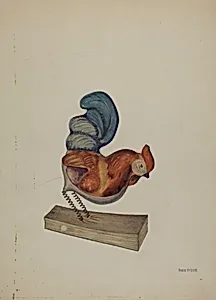
Pa. German Squeak Toy Rooster
c. 1938
Medium
watercolor, graphite, and colored pencil on paper
Dimensions
overall: 34.6 x 24.9 cm (13 5/8 x 9 13/16 in.) Original IAD Object: 7 3/8" high; 4 3/4" wide; 2 1/4" deep
Classification
Index of American Design
Department
CG-W
Museum
National Gallery of Art, Washington, D.C.
Credit
Index of American Design
Accession Number
1943.8.3721
Rights
Public Domain
Art Historical Context
**Pa. German Squeak Rooster** *Frank McEntee, c. 1938* Watercolor, graphite, and pencil on paper *34.6 × 24.9 cm (13⅝ × 9⅞ in.)* Index of American Design, National of Art Behold the vibrant charm of Frank McEntee's *Pa. German Sque Toy Rooster*, a 1938 rendering capturing the whimsical spirit of Pennsylvania German folk art. This watercolor, graphite, and colored pencil depiction faithfully reproduces a small wooden squeak toy—measuring just 7⅜ inches high, 4¾ inches wide, and 2¼ inches deep—crafted by the Pennsylvania Dutch community. Known for their bold colors and playful forms, these hand-carved toys featured simple mechanisms that produced squeaks when squeezed, bringing joy to children in rural 18th- and 19th-century America. Created as part of the Index of American Design (IAD), a Works Progress Administration (WPA) project during the Great Depression, McEntee's work preserves endangered examples of everyday American craftsmanship. The IAD commissioned artists like McEntee to document folk objects through precise, colorful plates, celebrating regional traditions amid economic hardship. Pennsylvania German toys, rooted in immigrant craftsmanship from Germany's Rhineland, reflect a blend of practicality and exuberance, symbolizing cultural resilience. McEntee's masterful use of layered watercolor for glossy surfaces, graphite for fine details, and colored pencil for accents creates a lifelike study that elevates the humble toy to artistic icon. This piece invites visitors to appreciate how folk art bridges history and play, a testament to America's creative heritage.