
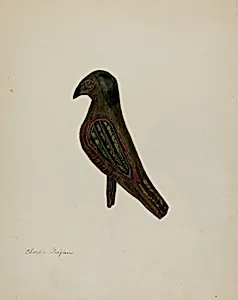
Pa. German Toy Bird
c. 1939
Medium
watercolor, graphite, and gouache on paperboard
Dimensions
overall: 28.6 x 22.8 cm (11 1/4 x 9 in.) Original IAD Object: 5 5/8" high
Classification
Index of American Design
Department
CG-W
Museum
National Gallery of Art, Washington, D.C.
Credit
Index of American Design
Accession Number
1943.8.3733
Rights
Public Domain
Art Historical Context
**Pa. German Toy Bird** *Charles Garjian, c. 1939* Watercolor, graphite, and gouache on paperboard *National Gallery of Art, Index of American Design* This delightful rendering captures a charming Pennsylvania German folk toy bird, meticulously documented by artist Charles Garjian around 1939 as part of the Index of American Design (IAD). Launched under the Works Progress Administration in the 1930s, the IAD employed artists to create precise, colorful studies of everyday American objects, preserving the nation's rich decorative arts heritage during the Great Depression. Garjian's depiction, scaled to 11¼ x 9 inches on paperboard, faithfully reproduces the original toy's modest 5⅝-inch height, highlighting the whimsical carved wooden birds beloved in Pennsylvania Dutch communities. Pennsylvania German folk art, rooted in 18th- and 19th-century immigrant traditions from the Palatinate region, is renowned for its bold colors, naive forms, and playful motifs—qualities vividly evoked here through Garjian's expert use of watercolor for fluid hues, graphite for fine outlines, and gouache for opaque, vibrant detailing. These toys, often handcrafted for children, embodied cultural values of ingenuity and joy amid rural life. Displayed in the National Gallery of Art, this work not only showcases Garjian's technical precision but also celebrates America's folk artistry, inviting visitors to appreciate the enduring spirit of handmade creativity.
About the Artist
Charles Garjian · 1900–1995
Charles Garjian is an artist whose biographical details are not well established in the major art historical sources. No confirmed dates, nationality, or documentation of his training and working period have been identified in available scholarship, making it difficult to place him with confidence within a particular tradition or movement. The works attributed to Garjian in museum collections sug...