
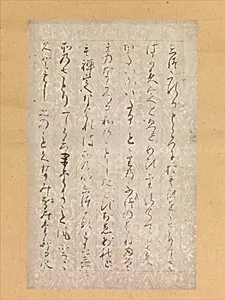
伝源俊頼書 『三宝絵詞』断簡 (東大寺切)|Page from Illustrations and Explanations of the Three Jewels (Sanbō e-kotoba), one of the “Tōdaiji Fragments” (Tōdaiji-gire)
Medium
Page from a book; ink on decorated paper
Dimensions
Image: 9 1/4 × 5 7/8 in. (23.5 × 15 cm) Overall with mounting: 49 3/16 × 13 3/8 in. (125 × 34 cm) Overall with knobs: 49 3/16 × 15 3/8 in. (125 × 39 cm)
Classification
Calligraphy
Culture & Period
Japan · Heian period (794–1185)
Department
Asian Art
Museum
Metropolitan Museum of Art, New York, NY
Credit
Mary Griggs Burke Collection, Gift of the Mary and Jackson Burke Foundation, 2015
Accession Number
2015.300.235
Rights
Public Domain
Art Historical Context
This exquisite fragment, titled *Page from Illustrations and Explanations of the Three Jewels (Sanbō e-kotoba)*, one of the renowned “Tōdaiji Fragments,” hails from Japan’s Heian period (794–1185), a golden age of courtly elegance and refined arts. Attributed to the calligraphy of Minamoto no Toshiyori, a celebrated poet, it dates to 1120 and forms part of an illustrated narrative scroll explaining the Buddhist Three Jewels—Buddha, Dharma, and Sangha. These fragments, preserved in fragments like this one, represent some of the earliest surviving emaki (picture scrolls), blending text and imagery to educate and inspire. Crafted as ink on lavishly decorated paper—a hallmark of Heian luxury, often adorned with gold flecks, colors, and patterns—this single page exemplifies the period’s mastery of calligraphy. Toshiyori’s fluid, rhythmic script captures the era’s aesthetic of *yūgen* (profound grace), where every stroke conveys spiritual depth. Measuring just 9¼ × 5⅞ inches, yet mounted grandly to nearly four feet, it evokes the scrolls’ original ritual unfolding in temple or noble settings. Housed in the Metropolitan Museum of Art’s Asian Art department, this piece from the Mary Griggs Burke Collection highlights Japan’s fusion of literature, Buddhism, and visual artistry, offering visitors a window into Heian Japan’s cultured devotion.