
Page of Calligraphy from a Shahnama (Book of Kings)
ca. 1610
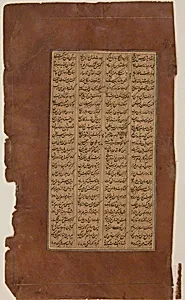
Medium
Ink, opaque watercolor, and gold on paper
Dimensions
H. 8 1/8 in. (20.6 cm) W. 4 3/4 in (12.1 cm)
Classification
Codices
Department
Islamic Art
Museum
Metropolitan Museum of Art, New York, NY
Credit
Gift of Wendy Findlay, 1982
Accession Number
1982.476.4
Rights
Public Domain
Tags
Art Historical Context
This exquisite page of calligraphy hails from a *Shahnama* (Book of Kings), the Persian epic composed by Abu'l Qasim Firda around 1010 CE. Dating to circa 1610, during the Safavid dynasty in Iran, this manuscript leaf captures the poetic retelling of Iran's mythical and historical kings, blending legend, heroism, and moral tales. As a single page from a codex—a bound book format—this artifact reflects the reverence for Firdausi's work, which became a cornerstone of Persian identity and literature, recited and illustrated across centuries. Crafted with ink, opaque watercolor, and gold on paper, the page exemplifies the pinnacle of Islamic calligraphy, likely in the elegant *nasta'liq* script favored for poetry. The modest dimensions (8 1/8 x 4 3/4 inches) belie its opulence: gold accents illuminate the text, while watercolor adds vibrant flourishes, evoking the illuminated manuscripts produced in royal workshops. Such pages were not mere text but artistic treasures, merging word and image to honor cultural heritage. Today, housed in the Metropolitan Museum of Art's Islamic Art Department (gift of Wendy Findlay, 1982), it invites us to marvel at how calligraphy transformed epic verse into visual poetry, bridging 11th-century composition with 17th-century artistry.
About the Artist
Abu'l Qasim Firdausi · 935–1020
Abu'l Qasim Firdausi, born around 940 in the village of Paj near Tus in Khorasan (modern-day Iran), emerged from a family of landed gentry known as dehqans, who preserved ancient Iranian oral traditions amid the cultural renaissance of the Samanid Empire. Little is documented about his early life or formal training, though he likely received a basic education including Arabic literacy, immersing h...