
Pair of Bracelets
1840
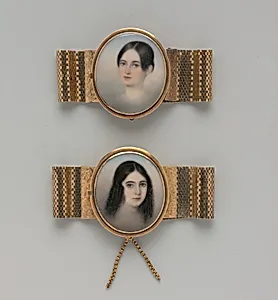
Medium
Gold, watercolor on ivory, hair
Dimensions
Bracelet (MLP): L. 5 1/4 in. (13.3 cm) Bracelet (CAP): L. 5 in. (12.7 cm) Miniatures: 1 7/16 x 1 3/16 in. (3.7 x 3 cm)
Classification
Bracelet
Culture
American
Department
The American Wing
Museum
Metropolitan Museum of Art, New York, NY
Credit
Dale T. Johnson Fund, 2001
Accession Number
2001.340a, b
Rights
Public Domain
Tags
About this artwork
These gold bracelets with portrait miniature clasps represent the work of John Carlin (1813-1891), a deaf artist who became one of New York's most sought-after miniaturists. Born in Philadelphia, Carlin graduated from the Pennsylvania Institute for the Deaf and Dumb, studied with John Rubens Smith and John Neagle of Philadelphia, then went to Paris to study with academic master Paul Delaroche. Upon returning to the United States, Carlin settled in New York where he established his reputation. Cr...
Art Historical Context
These exquisite gold bracelets, crafted by Carlin in 1840, showcase the miniaturist's mastery of watercolor on ivory portraits, a cherished pre-photography art form. Carlin (1813–1891), a deaf artist from Philadelphia, overcame personal challenges to become one of New York's most celebrated miniaturists. Educated at the Pennsylvania Institute for the Deaf and Dumb he trained under Philadelphia artists John Rubens Smith and Johnagle before honing his skills with academic master Paul Delaroche Paris. Returning to America, he settled in New York, producing nearly two thousand miniatures between 1841 and 1856—a testament to his prolific talent and commercial success. Each bracelet features a tiny, signed portrait (1 7/16 x 1 3/16 in.) of a young girl, delicately painted in watercolor on ivory and mounted in a gilt clasp case, with the ivory glued to white paper for stability. The incorporation of hair in the construction nods to sentimental jewelry traditions, evoking intimate family mementos. These dainty pieces, measuring about 5 inches long, blend jewelry craftsmanship with portraiture, allowing wearers to carry loved ones close. In antebellum America, such miniatures held profound emotional weight as portable keepsakes, capturing likeness and personality in a demanding medium. Carlin's technical precision elevated them to refined treasures, bridging art and personal devotion in an era of growing sentimentality.
About the Artist
John Carlin · 1813–1891
American, Philadelphia, Pennsylvania 1813–1891 New York