
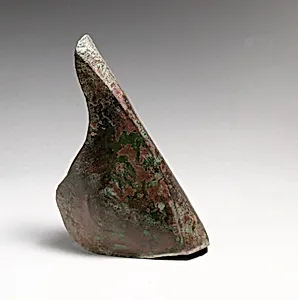
Pair of bronze ankle guards
Unknown Artist
5th century BCE
Medium
Bronze
Dimensions
left guard length 9 1/8in. (23.2cm) right guard length 8 15/16in. (22.7cm)
Classification
Bronzes
Culture & Period
Greek · Classical
Department
Greek and Roman Art
Museum
Metropolitan Museum of Art, New York, NY
Credit
Purchase, Norbert Schimmel Gift, and Arthur Darby Nock Bequest, in memory of Gisela M. A. Richter, 1982
Accession Number
1982.11.5, .6
Rights
Public Domain
Tags
Art Historical Context
These elegant bronze ankle guards, crafted in Classical Greece during the 5 century BCE, represent the pinnacle of ancient armor-making. Measuring about 9 inches in length—with the left slightly longer at 9 1/8 inches (23.2 cm) and the right at 15/16 inches (22.7 cm)—they were designed to protect the vulnerable ankles and lower shins of warriors, likelylites in phalanx formations. The asymmetry reflects custom fitting for the wearer’s legs, a practical touch in functional art. Bronze, an alloy of copper and tin, was the premier medium for Greek arms and armor, prized for its durability, shine, and workability. Artisans employed sophisticated lost-wax casting techniques to create these lightweight yet resilient pieces, balancing protection with mobility essential for the agile combat of the era. From the height of Athens’ Golden Age—marked by the Persian Wars and cultural triumphs like the Parthenon—these guards evoke a society where martial prowess intertwined with artistic excellence. Now housed in the Metropolitan Museum of Art’s Greek and Roman Art Department, acquired in 1982 through generous gifts honoring scholar Gisela M. A. Richter, they offer a tangible link to Classical ideals of beauty, strength, and heroism. Though by an unknown maker, their survival underscores bronze’s enduring legacy in preserving antiquity’s martial splendor.