
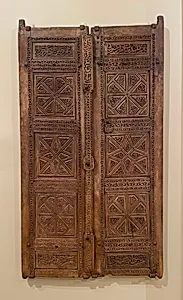
Pair of Carved Doors
Unknown Artist
dated A.H. [8]70/ 1466 CE
Medium
Wood (teak); carved
Dimensions
H. 59 1/4 in. (150.5 cm) W. 32 in. (81.3 cm) Gr. D. 3 1/2 in. (8.9 cm) Wt. 48 lbs (21.8 kg)
Classification
Wood
Department
Islamic Art
Museum
Metropolitan Museum of Art, New York, NY
Credit
Rogers Fund, 1935
Accession Number
35.127a, b
Rights
Public Domain
Art Historical Context
These intricately carved teak doors, dated to 1466 CE (A.H. 870), stand as a remarkable example of fifteenth-century Islamic woodwork. Created by an unknown artisan, the pair would have originally graced the entrance of a mosque, palace, or important civic building, where their presence signaled both protection and prestige. Teak, valued for its durability and rich grain, was often imported across trade routes, highlighting the extensive networks that connected the Islamic world with regions like South Asia. The carving technique demonstrates exceptional skill, transforming solid wood into a surface alive with geometric patterns and arabesque motifs typical of Islamic decorative traditions. Such doors served not only functional purposes but also conveyed cultural and spiritual values, inviting visitors to reflect on harmony, order, and divine beauty as they passed through. Acquired by the Metropolitan Museum of Art in 1935 through the Rogers Fund, this work offers modern viewers a tangible connection to the artistic achievements of the period. Its survival reminds us of the enduring legacy of anonymous craftsmen whose creations continue to inspire appreciation for Islamic art’s elegance and technical mastery.