
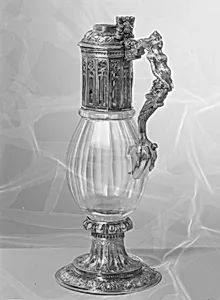
Pair of cruets
Unknown Artist
crystal and upper mount 15th century, handle and foot 17th century
Medium
Rock crystal, silver gilt
Dimensions
Height (each): 6 5/8 in. (16.8 cm)
Classification
Metalwork-Silver In Combination
Culture
German
Department
European Sculpture and Decorative Arts
Museum
Metropolitan Museum of Art, New York, NY
Credit
The Friedsam Collection, Bequest of Michael Friedsam, 1931
Accession Number
32.100.232, .233
Rights
Public Domain
Art Historical Context
This exquisite pair of cruets, crafted in Germany, exemplifies the luxurious metalwork of late medieval Europe. Dating to the 15th century for rock crystal bodies and upper silver-gilt mounts, with 17th-century handles and added later, these vessels stand at 6 5/8 inches (16.8 cm) tall. Rock crystal, a prized hardstone known for its luminous clarity, was meticulously carved into elegant forms, while the silver gilt—silver coated with a thin layer of gold—provided a radiant, opulent finish typical of ecclesiastical treasures. Cruets like these were essential in liturgical settings, holding holy oils or sacramental liquids during religious ceremonies. Their composite construction reflects centuries-old conservation practices, where cherished objects were lovingly restored rather than discarded, bridging Gothic precision with Baroque embellishments. German workshops excelled in such rock crystal carving during the 15th century, a technique demanding exceptional skill due to the material's brittleness and brilliance. Now housed in The Metropolitan Museum of Art's European Sculpture and Decorative Arts department, thanks to The Friedsam Collection (1931), these cruets offer a window into the piety and artistry of their era, blending functionality with spiritual splendor.