
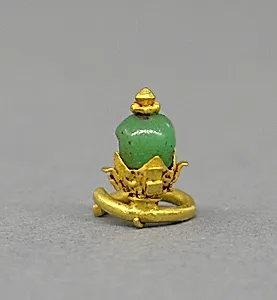
Pair of Ear Clips with Bead in Four-Prong Lotus Base Setting
Unknown Artist
Second half of the 8th–second half of the 10th century
Medium
Gold with bead
Dimensions
Each: H. 1/8 in. (0.3 cm); Diam. 3/8 in. (1 cm)
Classification
Jewelry
Culture & Period
Indonesia (Java) · Central Javanese period
Department
Asian Art
Museum
Metropolitan Museum of Art, New York, NY
Credit
The Samuel Eilenberg-Jonathan P. Rosen Collection of Indonesian Gold, Bequest of Samuel Eilenberg and Gift of Jonathan P. Rosen, 1998
Accession Number
1998.544.179a, b
Rights
Public Domain
Tags
Art Historical Context
These delicate ear clips, crafted from gold with a central bead set in a four-prong lotus base hail from Java, Indonesia, during the Central Javan period (second half of the 8th to second half of the10th century). Measuring just 1/8 inch high and 3/8 inch in diameter each, they exemplify the exquisite miniaturization of ancient metalworking techniques. The lotus motif, a recurring symbol in the region's art, evokes purity and spiritual enlightenment, deeply rooted in the Hindu-Buddhist traditions that flourished under dynasties like the Sailendras and Mataram. In the opulent courts of Central Java—home to monumental temples such as Borobudur and Prambanan—these clips would have adorned the elite, signaling wealth and piety. Gold's malleability allowed artisans to create intricate prong settings that securely held the bead while mimicking the lotus flower's petals, a clever fusion of functionality and symbolism. Such jewelry highlights Java's role as a maritime crossroads, blending local craftsmanship with influences from India and Southeast Asia. Now part of The Samuel Eilenberg-Jonathan P. Rosen Collection at The Metropolitan Museum of Art, this pair offers a glimpse into everyday luxury from a golden age of Javanese culture, where even the smallest adornments carried profound cosmic meaning.