
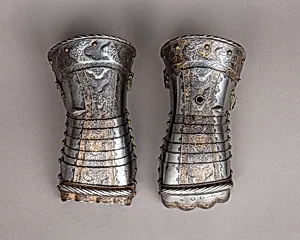
Pair of Gauntlets
Unknown Artist
ca. 1560
Medium
Steel, gold, copper alloy
Dimensions
L. 8 3/4 in. (22.2 cm); Gr. W. 4 5/8 in. (11.7 cm)
Classification
Armor Parts-Gauntlets
Culture
German, probably Augsburg
Department
Arms and Armor
Museum
Metropolitan Museum of Art, New York, NY
Credit
Gift of Clarence H. Mackay, 1912
Accession Number
12.87.1–.2
Rights
Public Domain
Art Historical Context
This exquisite pair of gauntlets, crafted around 1560 in Germany—likely the renowned armor-making center of Augsburg—represents the pinnacle of Renaissance defensive artistry. Measuring just 8¾ inches long, these steel protectors for the hands and wrists were essential components of a knight's full plate armor, shielding warriors during intense battles or ceremonial tournaments. At a time when European conflicts raged and chivalric ideals still held sway, such gear balanced lethal functionality with opulent display, reflecting the wearer's status. Forged from durable steel and embellished with gold and copper alloy, the gauntlets showcase advanced metalworking techniques. The steel provided unyielding protection against slashes and thrusts, while the precious metals—likely applied through gilding or intricate inlays—added a regal gleam, transforming mere armor into wearable sculpture. Augsburg's workshops were famed for this fusion of utility and luxury, exporting pieces to nobility across Europe. Today, gifted to the Metropolitan Museum of Art in 1912 by Clarence H. Mackay, these gauntlets offer a tangible glimpse into 16th-century martial culture, where craftsmanship met the clamor of combat. Imagine slipping them on: a perfect blend of brute strength and shimmering elegance.