
Pair of pedestals
Unknown Artist
ca. 1778
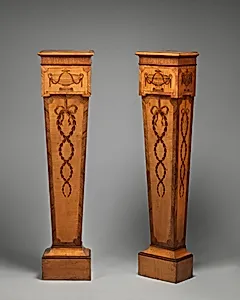
Medium
Pine carcase, satinwood veneer, inlaid with mahogany, rosewood and other woods
Dimensions
Overall (each): 55 × 13 × 8 in. (139.7 × 33 × 20.3 cm)
Classification
Woodwork-Furniture
Culture
British
Department
European Sculpture and Decorative Arts
Museum
Metropolitan Museum of Art, New York, NY
Credit
Gift of Irwin Untermyer, 1964
Accession Number
64.101.1054, .1055
Rights
Public Domain
Art Historical Context
This exquisite pair of pedestals, around 1778 by an unknown British artisan, exemplifies the refined elegance of late Georgian furniture. Standing at over 4 feet tall, each pedestal features a pine carcase—a sturdy, economical core—covered in satinwood veneer, a lustrous tropical wood prized for its golden hue and fine grain. Delicate inlays of mahogany, rosewood, and other contrasting woods add geometric patterns and subtle ornamentation, showcasing the meticulous craftsmanship of British woodworkers during the neoclassical revival. The use of veneering and inlay techniques was revolutionary in the 18th century, allowing artisans to achieve opulent surfaces on affordable bases while highlighting exotic imported woods from global trade routes. These pedestals would have served as elegant displays for sculptures, urns, or busts in grand country houses or London townhomes, embodying the era's taste for symmetry, proportion, and understated luxury inspired by ancient Greek and Roman designs. Today, housed in the Metropolitan Museum of Art's European Sculpture and Decorative Arts Department as a 1964 gift from Irwin Untermyer, they offer a window into Britain's golden age of furniture-making, where form met function in harmonious beauty. (198 words)