
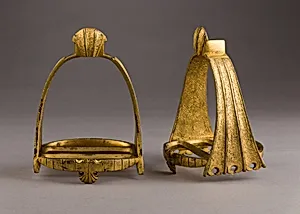
Pair of Stirrups
Unknown Artist
early 17th century
Medium
Copper alloy, gold
Dimensions
Stirrup (a); H. 6 3/4 in. (17.1 cm); W. 5 in. (12.7 cm); D. 4 5/8 in. (11.7 cm); Wt. 1 lb. 10.9 oz. (762.6 g); stirrup (b); H. 6 5/8 in. (16.8 cm); W. 5 in. (12.7 cm); D. 4 1/2 in. (11.4 cm); Wt. 1 lb. 0.8 oz. (759.8 g)
Classification
Equestrian Equipment-Stirrups
Culture
Italian
Department
Arms and Armor
Museum
Metropolitan Museum of Art, New York, NY
Credit
Gift of William H. Riggs, 1913
Accession Number
14.25.1756a, b
Rights
Public Domain
Art Historical Context
This exquisite pair of stirrups, crafted in early 17th-century Italy by an unknown artist, exemplifies the fusion of functionality and luxury in equestrian equipment. Made from copper alloy—a durable material akin to bronze—and adorned with gold, these stirrups measure about 6½ inches tall and weigh over a pound each, designed to support riders during mounted combat or travel. Housed in the Metropolitan Museum of Art's and Armor Department, they were generously gifted by William H. Riggs in 1913. In Renaissance and early Baroque Italy, stirrups were essential for cavalry and nobility, enabling secure footing for mounted warriors and enhancing control in battle. The lavish use of gold gilding highlights their status as elite accessories, likely owned by high-ranking individuals who valued both practicality and opulence. Italian metalworkers of the period were renowned for such intricate equestrian gear, blending robust engineering with decorative flair. These stirrups offer a glimpse into the martial culture of 17th-century Europe, where horsemanship symbolized power and prestige. Though their exact provenance remains mysterious, their preservation invites us to ponder the skilled hands that forged them amid Italy's vibrant artistic legacy.