
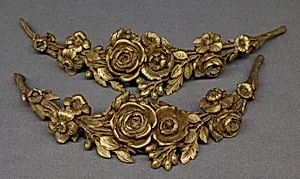
Pair of vase ornaments
Unknown Artist
18th century
Medium
Gilt bronze
Dimensions
Overall (.435a, confirmed): 3 in. × 7 3/8 in. × 1 1/4 in. (7.6 × 18.7 × 3.2 cm); Overall (.435b, confirmed): 3 3/4 × 6 3/8 × 1 1/8 in. (9.5 × 16.2 × 2.9 cm)
Classification
Metalwork-Gilt Bronze
Culture
French
Department
European Sculpture and Decorative Arts
Museum
Metropolitan Museum of Art, New York, NY
Credit
Gift of J. Pierpont Morgan, 1906
Accession Number
07.225.510.435a, b
Rights
Public Domain
Tags
Art Historical Context
This exquisite pair of gilt bronze vase ornaments, crafted in 18th-century France, exemplifies the era's passion for lavish decorative metalwork. The smaller ornament (7.6 × 18.7 × 3.2 cm) and its companion (9.5 16.2 × 2.9 cm) feature delicate motifs of leaves and roses,oking the natural elegance prized in French interiors. These diminutive yet intricate pieces were likely designed to adorn vases, adding a touch of opulence to tabletops or mantels in aristocratic homes. Gilt bronze a technique where a thin layer of gold is applied over bronze via mercury-gold amalgam (fire-gilding), was a hallmark of French luxury craftsmanship during the Rococo and early Neoclassical periods. This method created a radiant, durable finish that captured light beautifully, making such ornaments both functional and sculptural. Produced by an unknown artisan, they reflect the collaborative workshops of the time, where skilled founders and chasers produced items for the elite. A generous gift to the Metropolitan Museum of Art from J. Pierpont Morgan in 1906, these ornaments offer a glimpse into the refined world of 18th-century French decorative arts, blending artistry with everyday splendor. Visitors will appreciate their subtle asymmetry and floral details, perfect symbols of the period's joie de vivre.