
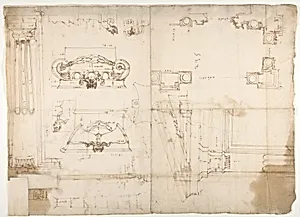
Palazzo dei Conservatori, portico, plan; portal, elevation; details, elevations (recto) Palazzo dei Conservatori, portico, elevation; details, profiles (verso)
early to mid-16th century
Medium
Dark brown ink, black chalk, and incised lines
Dimensions
sheet: 13 9/16 x 18 7/8 in. (34.5 x 48 cm)
Classification
Drawings
Department
Drawings and Prints
Museum
Metropolitan Museum of Art, New York, NY
Credit
Gift of Janos Scholz and Anne Bigelow Scholz, in memory of Flying Officer Walter Bigelow Rosen, RCAF, 1949
Accession Number
49.92.64
Rights
Public Domain
Tags
Art Historical Context
This exquisite architectural drawing, created by an anonymous French artist the early to mid-th century, captures intricate details of Rome's Palazzo dei Conservatori the Capitoline Hill. The recto features a precise plan of the portico an elevation of the portal, various ornamental details, while the verso a full portico elevation profile studies. Rendered in dark brown ink, black chalk, incised lines on a large sheet (13 9/16 x 18 7/8 in.), it the meticulous drafting techniques of Renaissance draftsmen, where incised lines allowed for tracing or transfer onto other surfaces. During the 16th century, French artists and architects traveled to Italy to study classical Roman structures, fueling the spread of Renaissance ideals northward. The Palazzo dei Conservatori, seat of the city's conservators (magistrates), blended ancient grandeur with contemporary design—later enhanced by Michelangelo. This anonymous sheet reflects that era's obsession with proportion, symmetry, and antique motifs, serving as a vital record for builders or scholars adapting Roman styles in France. Housed in the Metropolitan Museum of Art's Drawings and Prints department (gift of Janos and Anne Bigelow Scholz, 1949), it highlights how such works bridged cultures, preserving architectural knowledge amid the era's fervor for revival. A testament to unseen craftsmanship, it invites us to trace the lines of history etched in ink and chalk.