
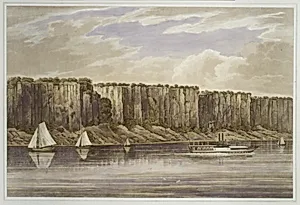
Palisades (No. 19 of The Hudson River Portfolio)
John Hill|William Guy Wall|Henry J. Megarey, 1823–24
About this artwork
"Palisades," the nineteenth plate from the groundbreaking *Hudson River Portfolio* (182–24), captures the majestic cliffs along the west side of the lower Hudson River. These towering formations, rising 350 to 550 feet and crowned with trees, embody the "savage grandeur of America's natural wonders. Created through a remarkable collaboration, Irish-born artist William Guy Wall the scene during his 1820 Hudson River; London-trained engraver John Hill transformed it an aquatint print and publisher Henry J. Megarey brought it to life. This proof before letters showcases the artwork in its purest form, hand-colored with watercolor for vivid atmospheric depth. As a landmark in early American printmaking, the *Portfolio* was the first major series to celebrate the sublimity of U.S. landscapes, fostering national pride in the young republic. Hill's masterful aquatint technique—ideal for rendering soft textures, misty skies, and geological drama—made these views accessible to a wide audience via affordable prints. Boats dotting the river below highlight human scale against nature's power. The series directly inspired the Hudson River School, America's first native landscape movement, paving the way for artists like Thomas Cole. Today, at The Metropolitan Museum of Art, this print invites us to marvel at how 19th-century visionaries turned wild scenery into symbols of cultural identity.