
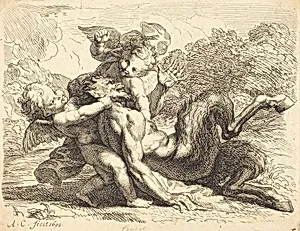
Pan Overcome by Putti
1692
Medium
etching and engraving on laid paper
Dimensions
sheet (trimmed close to plate mark): 17.2 x 21.9 cm (6 3/4 x 8 5/8 in.)
Classification
Department
CG-E
Museum
National Gallery of Art, Washington, D.C.
Credit
Ailsa Mellon Bruce Fund
Accession Number
1996.113.6
Rights
Public Domain
Art Historical Context
In the whimsical etching *Pan Overcome by Putti* (1692), French artist Antoine Coypel captures a playful mythological scene from classical antiquity. Pan, the horned god of the wild and shepherds, is gleefully overwhelmed by a swarm of mischievous putti—those cherubic childlike figures symbolizing love and frolic. Created during the lavish reign of Louis XIV, the work reflects the Baroque era's fondness for dynamic compositions blending humor, sensuality, and exuberant movement, hallmarks of Coypel's style as a leading history painter and draftsman at the French court. Coypel's mastery shines in this etching and engraving on laid paper, a technique combining the fluid, spontaneous lines of etching with the precise burr of engraving for rich tonal depth and intricate details. Measuring just 17.2 x 21.9 cm, the intimately scaled print (trimmed close to the plate mark) exemplifies how 17th-century printmaking democratized elite art, allowing designs from grand Versailles tapestries or paintings to reach wider audiences. Acquired through the Ailsa Mellon Bruce Fund for the National Gallery of Art's Prints department, it highlights Coypel's versatility beyond oil painting. This delightful piece invites visitors to ponder the Baroque delight in subverting the mighty—here, the rustic Pan tamed by innocent joy—offering a lighthearted glimpse into France's golden age of art.
About the Artist
Antoine Coypel · 1661–1722
Comment on works: History