
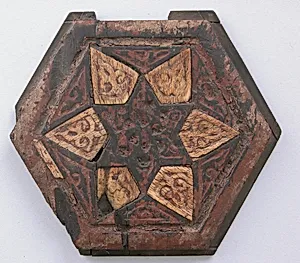
Panel
Unknown Artist
14th–15th century
Medium
Wood; carved, inlaid with plain and carved ivory
Dimensions
Ht. 6 9/16 in, (16.7 cm) W. 4 3/4 in. (12.1 cm) D. 1/2 in. (1.2 cm)
Classification
Wood
Department
Islamic Art
Museum
Metropolitan Museum of Art, New York, NY
Credit
Rogers Fund, 1907
Accession Number
07.236.54
Rights
Public Domain
Art Historical Context
This exquisite wooden panel, crafted by an unknown artist in the 14–15th century, the refined artistry of Islamic decorative traditions. Measuring just 6 9/ inches high and 4 3/4 inches wide, its compact form suggests it may have adorned furniture, caskets, or architectural elements like doors in mosques or palaces. The medium—wood meticulously carved and inlaid with both plain and intricately carved—highlights a luxurious technique prized in the medieval Islamic world, where such hybrid materials created shimmering contrasts and intricate patterns. In the Islamic Art collection at The Metropolitan Museum of Art (acquired through the Rogers Fund in 1907), this panel reflects the era's mastery of intarsia and marquetry-like inlays. Ivory, a rare and precious import, elevated everyday objects into symbols of wealth and piety, often featuring geometric motifs or arabesques that evoke spiritual harmony without figurative representation. These small-scale works showcase the patience of anonymous workshops, likely in regions like Egypt or Syria under Mamluk patronage, where craftsmanship intertwined with cultural devotion. Visitors will appreciate how this delicate artifact captures the timeless elegance of Islamic design, blending functionality with breathtaking detail in a single, palm-sized treasure.