
Panel
Unknown Artist
14th–15th century
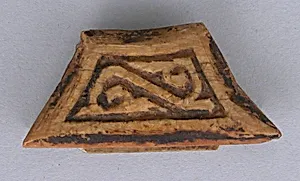
Medium
Wood; carved
Dimensions
H. 3/4 in. (1.9 cm) Max W. 1 1/2 in. (3.8 cm) D. 1/4 in. (0.6 cm) Wt. 0.165 oz. (4.678 g)
Classification
Wood
Department
Islamic Art
Museum
Metropolitan Museum of Art, New York, NY
Credit
Rogers Fund, 1907
Accession Number
07.236.126
Rights
Public Domain
Art Historical Context
This delicate carved wooden panel, dating to the 14th–15th century, hails from the Islamic world and exemplifies the craftsmanship of medieval artisans. Produced during a golden age of Islamic art—spanning regions like Mamluk Egypt, Syria, or Persia—these small objects were often integral to larger decorative ensembles, such as furniture inlays, architectural screens, or pious boxes. Acquired through the Rogers Fund in 1907, it now resides in the Metropolitan Museum Art's Islamic Art Department, offering a glimpse into everyday luxury and spiritual refinement. Crafted from wood, the panel measures just 3/4 inch high, 1 1/2 inches wide, and 1/4 inch deep, weighing a mere 0.165 ounces—highlighting the precision required for such miniature work. Carving techniques in Islamic art favored intricate reliefs, geometric patterns, or arabesques, achieved through fine chisels and abrasives to create depth and texture on a tiny scale. This piece's portability suggests it may have adorned personal items, blending functionality with artistry. In the broader context of Islamic decorative arts, such panels underscore a cultural emphasis on aniconism—favoring abstract motifs over figural representation—while showcasing technical virtuosity. Though its exact design remains unrecorded here, it invites visitors to appreciate the anonymous master's skill, where every curve reflects centuries of transmitted knowledge.