
Panel
Unknown Artist
14th–15th century
Medium
Wood; inlaid with ivory
Dimensions
Max H. 5/8 in. (1.6 cm) Max W. 3 1/16 in. (7.8 cm) D. 5/16 in. (0.8 cm) Wt. 0.12 oz. (3.402 g)
Classification
Wood
Department
Islamic Art
Museum
Metropolitan Museum of Art, New York, NY
Credit
Rogers Fund, 1907
Accession Number
07.236.127
Rights
Public Domain
Art Historical Context
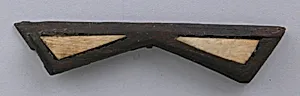
This delicate wooden panel, inlaid with ivory, hails from the Islamic world of the 14th–15th century. Measuring just 5/8 inches high and 3 1/16 inches wide, its diminutive size belies the exquisite craftsmanship evident in its construction. Acquired through the Rogers Fund in 7 and now housed in the Metropolitan Museum Art's Islamic Art department, it exemplifies the refined artistry of the medieval Islamic tradition. The technique of inlaying ivory into woodknown as marquetry or parquetry in broader terms—was a hallmark of Islamic decorative arts during this era. Artisans meticulously cut and fitted thin ivory pieces into the wood base, creating intricate patterns that catch the light and highlight the contrasting textures and colors. Such panels were likely components of furniture, caskets, or architectural elements, showcasing the opulence and technical virtuosity prized in courts from Egypt to Syria. Though the artist remains unknown, this panel's survival speaks to the enduring appeal of Islamic material culture. Its lightweight form (just 0.12 oz.) and precise proportions invite visitors to marvel at the patience required for such micro-scale work, offering a window into a world where beauty was crafted in the smallest details.