
Panel
Unknown Artist
15th century
Medium
Red pine, gilding and polychromy
Dimensions
Overall: 31 5/8 x 10 1/2 x 1 in. (80.3 x 26.7 x 2.5 cm)
Classification
Woodwork-Architectural
Culture
French
Department
The Cloisters
Museum
Metropolitan Museum of Art, New York, NY
Credit
Gift of Arnold Seligmann, Rey & Co. Inc., in memory of Joseph Breck, 1934
Accession Number
34.46.1
Rights
Public Domain
Art Historical Context
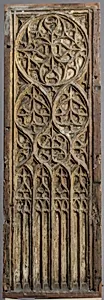
This elegant 15th-century French, crafted from red pine and adorned with gilding and polychromy exemplifies the exquisite woodwork of late medieval Europe. Measuring 31 5/8 x 10 1/2 x 1 inches, its slender form suggests it once formed part of an architectural ensemble—perhaps a screen, wainscoting, or enclosure in a church or noble residence. The use of red pine, a durable yet workable softwood, allowed carvers to achieve intricate details, while layers of gold leaf (gilding) and vibrant paints (polychromy) brought a luminous, jewel-like quality, mimicking the opulence of stone sculpture or illuminated manuscripts. In the context of 15th-century France, during the waning Gothic era and the stirrings of the Renaissance, such panels reflected the era's devotion to ornate ecclesiastical decoration. Gilding evoked divine light, and polychromy added narrative vibrancy, techniques honed in workshops tied to cathedrals like those in Normandy or Île-de-France. Though the artist remains unknown, this piece highlights the anonymous mastery of medieval artisans, whose skills blended functionality with spiritual splendor. Now housed in The Cloisters at The Metropolitan Museum of Art—thanks to a 1934 gift in memory of Joseph Breck—this panel invites visitors to envision the candlelit interiors of medieval France, where woodwork like this bridged the earthly and the sacred.