
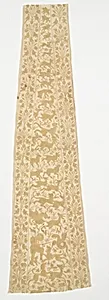
Panel from a Mantle or Apron
Unknown Artist
early 17th century
Medium
Cotton, tasar silk; plain weave, embroidered
Dimensions
Textile a: H. 46 3/4 in. (118.7 cm) W. 13 1/2 in. (34.3 cm) Textile b: H. 45 in. (114.3 cm) W. 14 1/4 in. (36.2 cm) Textile c-e: H. 46 in. (116.8 cm) W. 15 1/4 in. (38.7 cm) Mount (Textile b:) H. 48 ½ in (123.2 cm) W. 18 in. (45.7 cm) D. 2 ¼ in. (5.7 cm)
Classification
Textiles-Embroidered
Department
Islamic Art
Museum
Metropolitan Museum of Art, New York, NY
Credit
Rogers Fund, 1908
Accession Number
08.108.4a–e
Rights
Public Domain
Tags
Art Historical Context
This exquisite *Panel from a Mantle or Apron*, crafted in the early 17th century, the masterful embroidery traditions of Islamic art. Composed of cotton plainweave adorned with tasar silk— a lustrous, textured wild silk— these panels (five in total, varying slightly in size around 46 inches high and 13-15 inches wide) likely part of a ceremonial garment. Acquired through the Rogers Fund in 8, they now grace the Metropolitan Museum of Art Islamic Art collection. The embroidery bursts with vibrant figurative scenes featuring men, horses, and animals, a hallmark of textiles from regions like Mughal India or Safavid Persia, where such motifs evoked tales of heroism, hunting, or daily life. The fine stitching highlights the artisan's skill in blending practicality with artistry; these wearable panels would have draped elites, symbolizing status and cultural sophistication during a golden age of Islamic textile production. Though the artist remains unknown, the work's preservation reveals the enduring allure of embroidered textiles— not just functional adornments, but storytelling canvases that bridged utility and opulence in 17th-century Islamic society. A true gem for contemplating fashion as fine art!