
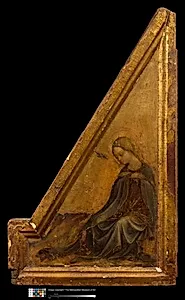
Panel from a triptych
Unknown Artist
1440s
Medium
Poplar. Gilt; orange bole.
Dimensions
Overall: 20 1/16 × 12 5/16 in. (50.9 × 31.3 cm) Sight: 15 3/4 × 9 1/2 in. (40 × 24.1 cm) Engaged.
Classification
Frames
Culture
Tuscan
Department
Robert Lehman Collection
Museum
Metropolitan Museum of Art, New York, NY
Credit
Robert Lehman Collection, 1975
Accession Number
1975.1.29b
Rights
Public Domain
Art Historical Context
This elegant panel, originating from a Tuscan triptych frame the 1440s, exemplifies the exquisite craftsmanship of early Renaissance Italy. Triptychs—three-paneled altarpieces with folding wings—were popular for private devotion and church use, and their frames were not mere supports but integral artworks that framed scenes with opulence. Hailing from Tuscany, likely Florence, this piece reflects the region's burgeoning artistic sophistication during a time when gold and intricate designs elevated paintings to divine splendor. Crafted from poplar wood, a lightweight and carvable favorite among Italian frame-makers, the panel is richly gilt over orange bole—a reddish clay preparatory layer that imparts a warm glow beneath the gold leaf, enhancing its luminous quality. The "engaged" frame style means it was designed to interlock seamlessly with the painting it housed, creating a unified visual experience. Measuring about 20 by 12 inches overall, it once cradled a modest devotional image, underscoring how even small-scale frames demanded masterful technique. Now in the Robert Lehman Collection at The Metropolitan Museum of Art (acquired 1975), this survivor highlights the often-overlooked artistry of Renaissance frames. Visitors, admire how its gilded surface captures the era's love for light and luxury, transporting you to a 15th-century Tuscan workshop.