
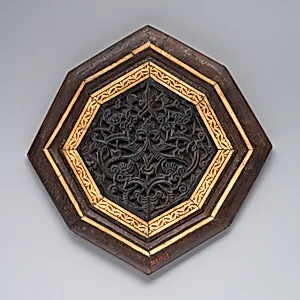
Panel from Minbar
Unknown Artist
14th–15th century
Medium
Wood; carved, inlaid with carved ivory
Dimensions
Ht. 6 5/8 in. (16.8 cm) W. 6 15/16 in. (17.6 cm) D. 9/16 in. (1..4 cm)
Classification
Wood
Department
Islamic Art
Museum
Metropolitan Museum of Art, New York, NY
Credit
Edward C. Moore Collection, Bequest of Edward C. Moore, 1891
Accession Number
91.1.1609
Rights
Public Domain
Tags
Art Historical Context
This exquisite wooden panel, hailing from a minbar—a raised pulpit in a mosque used for delivering sermons—dates to the 14th–15th century and exemplifies the refined craftsmanship of Islamic art. Minbars were among the most prestigious architectural elements in mosques, often by rulers or wealthy patrons to showcase piety and artistic prowess. Though the artist remains unknown, the panel's small size (just over 6 inches square and remarkably thin at under 1 inch deep) suggests it was one of many intricate components forming a larger structure, likely from the Mamluk or related regions where such woodwork flourished. Crafted from wood and inlaid with finely carved ivory, the panel highlights virtuoso techniques like piercing, undercutting, and precise marquetry. Ivory inlays added a luminous contrast and symbolic value, evoking purity and luxury in religious contexts. These methods not only demonstrated technical mastery but also adhered to Islamic aniconism, favoring geometric patterns, arabesques, and architectural motifs—hinted at by its "Architecture" tag—that created rhythmic, hypnotic surfaces. Today, this fragile treasure resides in the Metropolitan Museum of Art's Islamic Art Department, part of the Edward C. Moore Collection (bequeathed 1891). It invites visitors to marvel at how medieval artisans transformed humble wood into a portal of spiritual elevation, bridging faith, art, and architecture across centuries.