
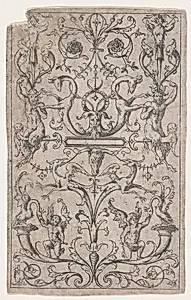
Panel of Grotesques
1530–85
Medium
Etchings
Dimensions
Sheet: 4 3/16 × 2 5/8 in. (10.6 × 6.6 cm)
Classification
Prints
Department
Drawings and Prints
Museum
Metropolitan Museum of Art, New York, NY
Credit
Bequest of Herbert Mitchell, 2008
Accession Number
2018.839.57.4
Rights
Public Domain
Art Historical Context
In the lively world of French Renaissance ornamentation, Jacques Androu Du Cerceau's *Panel of Grotesques* (1530–85) captures the whimsical spirit of the era. This intimate etching, measuring just 4 3/16 × 2 5/8 inches, showcases Du Cerceau's mastery as an architect-turned-printmaker. Born around 1511, he was a key figure in disseminating innovative designs through books and prints, bridging ancient Roman inspirations with 16th-century French tastes. Grotesques—fantastical motifs blending human, animal, and vegetal forms—drew from rediscovered Roman decorations unearthed in Nero's Domus Aurea. Du Cerceau's panel exemplifies this revival, teeming with intricate, asymmetrical patterns ideal for architectural embellishments like friezes or book illustrations. Etching, a relatively new technique in France that he helped popularize, allowed for fine, fluid lines that etched acid into metal plates, producing detailed reproductions far beyond woodcuts. Housed in the Metropolitan Museum of Art's Drawings and Prints department (Bequest of Herbert Mitchell, 2008), this work highlights prints' role in democratizing high art. Collectors and artisans pored over such panels, fueling the ornate styles of Fontainebleau and beyond, making Du Cerceau's legacy enduring in decorative arts.
About the Artist
Jacques Androuet Du Cerceau · 1510–1585
Jacques I Androuet du Cerceau (c. 1510–1584), born in Paris to a wine merchant, emerged as a pivotal figure in introducing Renaissance architecture to France through his innovative designs and engravings. Trained as an architect, decorator, and engraver, he established a printshop in Orléans around 1549, where he began producing influential suites of engravings, starting with triumphal arches. His...