
Panel (see also 1975.1.1932)
late 19th–early 20th century
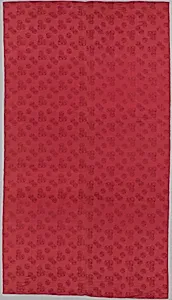
Medium
Red silk.
Dimensions
Height: 287.7 cm. Width: 161 cm. repeat: 14.3 cm. x 19.7 cm.; loomed width: 80.7 cm.
Classification
Textiles-Woven
Culture
Chinese
Department
Robert Lehman Collection
Museum
Metropolitan Museum of Art, New York, NY
Credit
Robert Lehman Collection, 1975
Accession Number
1975.1.1933
Rights
Public Domain
Art Historical Context
This striking red silk panel, woven in China during the late 19th to early 20th century, exemplifies the exquisite craftsmanship of traditional Chinese textile production. Measuring an impressive 287.7 cm in height and 161 cm in width, it features a repeating pattern of 14.3 x 19.7 cm, designed for seamless extension across larger surfaces. The vibrant red hue, a color deeply symbolic of good fortune, joy, and prosperity in Chinese culture, would have adorned homes, temples, or ceremonial spaces, transforming ordinary interiors into festive displays. Crafted on a loom with a width of 80.7 cm, the panel showcases advanced weaving techniques honed in silk-producing hubs like Suzhou or Nanjing during the waning Qing Dynasty and early Republican era. This period marked a blend of imperial traditions and modern influences, as weavers employed intricate drawlooms or early Jacquard mechanisms to create durable, finely detailed motifs—likely floral, auspicious symbols, or geometric designs suited for panels in folding screens or wall hangings. Housed in the Robert Lehman Collection at The Metropolitan Museum of Art (1975.1.1931, see also 1975.1.1932), this textile highlights the global allure of Chinese silk, prized by collectors for its technical mastery and cultural resonance. Visitors can appreciate how such panels bridged art and daily life, embodying China's millennia-old legacy of silk innovation.
About the Artist
Chinese
The artist known simply as "Chinese" in museum records represents the vast tradition of anonymous or unattributed masters in Chinese art history, with 99 works preserved in our collection. These pieces exemplify the enduring legacy of guó huà, or traditional Chinese painting, one of the world's oldest continuous artistic practices. Early life is not well documented, as is common for many practitio...