
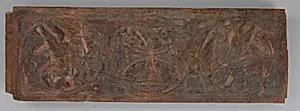
Panel with Cross and Griffins
Unknown Artist
6th–7th century
Medium
Wood; carved and painted
Dimensions
H. 6 7/16 in. (16.4 cm) W. 19 11/16 in. (50 cm) D. 3 3/8 in. (8.6 cm) Wt.
Classification
Wood
Department
Islamic Art
Museum
Metropolitan Museum of Art, New York, NY
Credit
Rogers Fund, 1928
Accession Number
28.12
Rights
Public Domain
Art Historical Context
This exquisite wooden panel, carved and painted by an unknown artist in the6th–7th, offers a glimpse into the vibrant artistic traditions of the early Islamic world. Measuring just over 19 inches wide and 6 inches high, its compact form suggests it may have adorned furniture, doors, or architectural elements, showcasing the era's skilled woodworking techniques. The relief carving, enriched with paint, highlights the intricate interplay of form and color typical of Late Antique and early Islamic craftsmanship, where wood served as an accessible yet expressive medium for storytelling. At its center, a prominent cross evokes Christian symbolism, while flanking griffins—mythical creatures with the body of a lion and head of an eagle—draw from ancient Near Eastern and Persian motifs, symbolizing power and protection. This fusion reflects the cultural crossroads of the time, as Byzantine, Sasanian, and emerging Islamic influences mingled in regions like Syria or Egypt. Housed in the Metropolitan Museum of Art's Islamic Art department (acquired via the Rogers Fund in 1928), the panel underscores the religious and artistic syncretism of the period, bridging pre-Islamic heritage with new expressions of faith. Visitors will appreciate how such artifacts reveal everyday beauty in a transformative age, inviting us to ponder the shared visual language of diverse civilizations.