
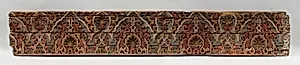
Panel with Cusped Arches
Unknown Artist
14th century
Medium
Wood (cedar); carved and painted
Dimensions
H. 19 in. (48.3 cm) W. 121 in. (307.3 cm) D. 2 3/4 in. (7cm) Wt. including crate 247 lbs. (112 kg) crate maybe half of this weight.
Classification
Wood
Department
Islamic Art
Museum
Metropolitan Museum of Art, New York, NY
Credit
Mr. and Mrs. Isaac D. Fletcher Collection, Bequest of Isaac D. Fletcher and Rogers Fund, by exchange, 1985
Accession Number
1985.241
Rights
Public Domain
Art Historical Context
This exquisite *Panel with Cusped Arches*, in the 14th century by an artist, exemplifies the refined woodwork of Islamic art. Fashioned from cedar wood, meticulously carved and painted, the panel measures an impressive 121 inches wide by 19 inches high, suggesting it once adorned a grand architectural setting—perhaps a mosque, palace, or madrasa. Its slender depth of just under 3 inches and substantial weight (around 247 pounds including its crate) highlight the craftsmanship required to create such a durable yet decorative element. Cusped arches, a hallmark of Mamluk-era architecture in Egypt and Syria during the medieval Islamic world, feature delicate, pointed lobes that evoke intricate stonework translated into wood. This technique allowed artisans to mimic lavish masonry while using more accessible materials, blending functionality with opulence. The painting likely added vibrant colors and gilding, enhancing its role in sacred or elite spaces where light and shadow would dance across the motifs. Housed in the Metropolitan Museum of Art's Islamic Art Department, thanks to the Isaac D. Fletcher bequest, this panel invites visitors to ponder the anonymous genius behind it—a testament to the era's cultural flourishing, where architecture and decoration intertwined to inspire awe and devotion.