
Panthea Stabs Herself beside the Corpse of Abradatas
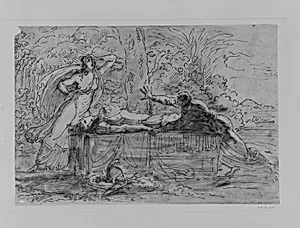
Medium
Brown ink, washes, and black chalk on white laid paper
Dimensions
8 1/4 x 12 3/16 in. (21 x 31 cm)
Classification
Drawing
Culture
American
Department
The American Wing
Museum
Metropolitan Museum of Art, New York, NY
Credit
Gift of Cephas G. Thompson, 1887
Accession Number
87.12.167 verso
Rights
Public Domain
Tags
Art Historical Context
In this poignant drawing, *Panthea Stabs Herself the Corpse of Abratas*, Benjamin West captures a dramatic moment from Xenophon's ancient Greek text *Cyropaedia*. The depicts Panthea, the devoted wife of the Median king Abradatas, falls in battle. Overcome by grief and loyalty, she takes her own life beside his body—a tale of profound tragic love that resonated with neoclassical artists like West, emphasizing virtue, heroism, and human emotion. West, a leading American-born painter who bridged colonial and European art worlds, worked in a neoclassical style inspired by antiquity. Created with brown ink, washes, and black chalk on laid paper, this preparatory study showcases his mastery of mixed media: fluid washes build atmospheric depth and shadow, while chalk adds texture to the figures' anguished forms. The intimate scale (8¼ x 12⅜ in.) invites close viewing, highlighting the raw intensity of suffering, nudity, and weaponry. Housed in The Metropolitan Museum of Art's American Wing as a gift from Cephas G. Thompson in 1887, the work reflects West's enduring influence on American art. It offers a window into 18th-century interpretations of classical stories, blending historical narrative with emotional power for timeless appeal.
About the Artist
Benjamin West · 1738–1820
Benjamin West, born on October 10, 1738, in Springfield, Pennsylvania, emerged as one of the most influential painters of his era despite being entirely self-taught. Growing up in a Quaker family in colonial America, West displayed prodigious talent from childhood, creating portraits and religious scenes with materials gifted by local patrons. By his late teens, he had garnered enough support to t...