
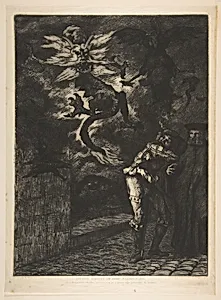
Panurge sortant de chez Raminagrobis
Medium
Etching; third state of three
Dimensions
Sheet: 14 9/16 × 10 11/16 in. (37 × 27.1 cm) Plate: 13 13/16 × 10 1/8 in. (35.1 × 25.7 cm)
Classification
Prints
Department
Drawings and Prints
Museum
Metropolitan Museum of Art, New York, NY
Credit
The Elisha Whittelsey Collection, The Elisha Whittelsey Fund, 1968
Accession Number
68.542.29
Rights
Public Domain
Tags
Art Historical Context
In the mid-19th century, etcher Félix Bracquem created *Panurge sortant de chezaminagrobis* (Panurge Leaving Raminagrobis's), a captivating illustration drawn from François Rabelais's satirical masterpiece *Gargantua and Pantuel*. Produced between 1854 and 1855, this etching—published by Alfred Cadart printed by Auguste Delâtrecaptures a pivotal moment in the Fourth Book, where the roguish Panurge departs the poet Raminagrobis after hearing ominous prophecies of doom. The third state of three represents the final, refined version, showcasing Bracquemond's mastery in printmaking during a revival of etching in France. Rendered in intricate line work on a copper plate, the medium allows for rich tonal contrasts and fine details that evoke tension and dread—themes echoed in the tags of fear, men, and monsters. Bracquemond's precise incisions, bitten by acid, bring Rabelais's fantastical world to life, blending Renaissance literary humor with 19th-century Romantic sensibilities. At 13 13/16 × 10 1/8 inches, the plate size emphasizes intimate drama, ideal for collectors. This print holds cultural significance as part of the Elisha Whittelsey Collection at The Metropolitan Museum of Art, highlighting how 19th-century artists reinterpreted Rabelais's bawdy, grotesque tales to explore human folly and the macabre. A testament to etching's versatility, it invites visitors to ponder Panurge's wide-eyed terror amid lurking shadows.
About the Artist
Félix Bracquemond|Alfred Cadart|François Rabelais|Auguste Delâtre · 1833–1914
French, Paris 1833–1914 Sèvres