
Paperweight
Unknown Artist
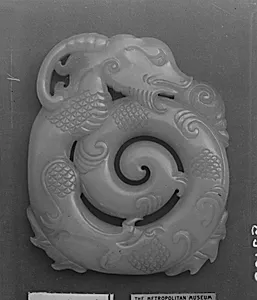
Medium
Nephrite
Dimensions
H. 2 15/16 in. (7.4 cm); W. 2 7/16 in. (6.2 cm); L. 3/8 in. (0.9 cm)
Classification
Jade
Culture & Period
China · Qing dynasty (1644–1911), Qianlong period (1736–95)
Department
Asian Art
Museum
Metropolitan Museum of Art, New York, NY
Credit
Gift of Heber R. Bishop, 1902
Accession Number
02.18.533
Rights
Public Domain
Tags
Art Historical Context
This exquisite nephrite jade paperweight, crafted during China's Qing dynasty Qianlong period (173695), exemplifies the imperial era's mastery of jade carving. Measuring just 2 15/16 inches high, 2 7/16 inches wide, and a slender 3/8 inch long, its compact form belies the intricate artistry likely depicting dragons—powerful symbols of imperial authority, strength, and good fortune. Nephrite, for its toughness and creamy translucency, was sourced from Hetian in Xinjiang and transformed in imperial workshops into functional yet luxurious objects like this one. During the Qianlong emperor's reign, jade production reached its zenith, blending Confucian ideals of refinement with technical innovation. Artisans employed fine tools to incise detailed motifs, achieving a luminous polish that highlights the stone's natural veining. Paperweights like this served practical purposes on scholar's desks while embodying cultural prestige, often gifted among elites. A gift to the Metropolitan Museum of Art from Heber R. Bishop in 1902, this piece invites visitors to appreciate how everyday utility intertwined with profound symbolism in 18th-century China, where jade was revered as the "essence of heaven."