
Papyrus Fragment
Unknown Artist
8th–10th century
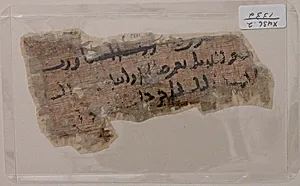
Medium
Ink on papyrus
Dimensions
H. 4 7/8 in. (12.4 cm) W. 2 5/16 in. (5.9 cm)
Classification
Codices
Department
Islamic Art
Museum
Metropolitan Museum of Art, New York, NY
Credit
Museum Accession
Accession Number
x.436.2
Rights
Public Domain
Art Historical Context
This delicate Papyrus Fragment, dating to the 8th–10th century, offers a tantalizing glimpse into the everyday world of early Islamic Egypt. Crafted with ink on papyrus—a lightweight, plant-based material imported from the Nile Delta—this tiny artifact measures just 4 7/8 by 2 5/16 inches, yet it survives as a fragment of a codex, likely a bound book or document. Housed in the Metropolitan Museum of Art's Islamic Department, it exemplifies the practical use of papyrus for writing before paper's widespread adoption. Inscribed in Arabic script, the fragment bears tags suggesting correspondence or official documents, reflecting the administrative and personal communications that buzzed through the burgeoning Islamic world under the Umayyad and Abbasid caliphates. Papyrus was prized for its affordability and abundance, enabling high levels of literacy and bureaucracy. The fluid ink calligraphy, executed with reed pens, highlights early mastery of angular Kufic or transitional scripts, blending functionality with aesthetic grace. Though its full text eludes us, this unassuming piece whispers of commerce, governance, and human connections across centuries. Visitors, pause to appreciate how such humble survivors illuminate the vibrant intellectual life of medieval Islam.