
Papyrus fragment
Unknown Artist
4th century B.C.–A.D. 6th century or later
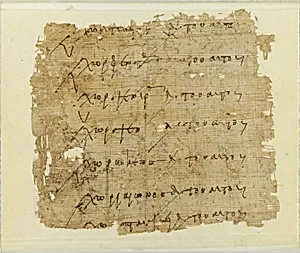
Medium
Papyrus, ink
Dimensions
H. 11.2 cm (4 7/16 in.); Framed: H. 11.4 cm (4 1/2 in.); W. 12.7 cm (5 in.)
Classification
Papyrus, Greek
Period
Ptolemaic–Byzantine Period
Department
Egyptian Art
Museum
Metropolitan Museum of Art, New York, NY
Credit
Museum Accession
Accession Number
O.C.3556
Rights
Public Domain
Art Historical Context
This delicate papyrus fragment, dating from the 4th century.C. through the 6th century.D. or later, offers a glimpse into the enduringal traditions of ancient Egypt during the Ptolema–Byzantine Period Housed in the Metropolitan Museum Art's Department of Egyptian Art, it just 11.2 cm in height, a small survivor framed for preservation. Crafted with ink on papyrus—a reed-based paper that was the backbone of Egyptian writing for millennia—this artifact exemplifies the medium's versatility for everything from administrative records to sacred texts. The Ptolemaic era began with Greek rulers following Alexander the Great's conquest, blending Hellenistic influences with deep-rooted Egyptian customs, while the Byzantine phase introduced Christian elements under Roman and later Eastern Roman rule. Such fragments bridge these worlds, preserving traces of daily life, literature, or ritual in a time of cultural fusion. Ink applied with reed pens allowed for precise, fluid script, reflecting advanced techniques honed over centuries. Though its exact content remains unspecified, this piece underscores papyrus's cultural primacy as Egypt's chief export and communicative tool, illuminating the resilience of written heritage amid political shifts. A testament to antiquity's fragility, it invites visitors to ponder the voices echoing from the Nile's ancient marshes.