
Papyrus Fragment of a Letter
Unknown Artist
580–640
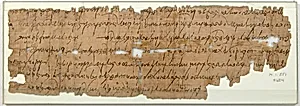
Medium
Papyrus with ink
Dimensions
Overall (14.1.544 & .551 together): 3 7/8 × 12 1/16 in. (9.8 × 30.6 cm) Framed (14.1.544 & .551 together): 4 × 12 5/8 in. (10.1 × 32.1 cm)
Classification
Papyrus
Culture
Coptic
Department
Medieval Art
Museum
Metropolitan Museum of Art, New York, NY
Credit
Rogers Fund, 1914
Accession Number
14.1.551a, b
Rights
Public Domain
Art Historical Context
This delicate papyrus fragment, dating 580–640 CE, preserves a portion of a personal letter written in Greek ink. Housed in the Metropolitan Museum of Art's Medieval Art department, it from Coptic culture in late antique Egypt, a time when Christianity flourished amid the transition from Byzantine rule to early Islamic influence. As a rare survivor of everyday correspondence, it offers a glimpse into the literacy and social connections of ordinary people in a world where papyrus was the premier writing surface, lightweight and abundant from the Nile Delta. The fragment's significance lies in its unadorned script, executed with fluid ink strokes on this perishable medium, which rarely endured the centuries. Papyrus manuscripts like this illuminate Coptic daily life—trade, family matters, or community news—preserved thanks to Egypt's dry climate. Measuring about 3 7/8 × 12 1/16 inches when reassembled, it exemplifies how such artifacts bridge the gap between monumental art and intimate human stories, acquired through the Rogers Fund in 1914. Though the sender and recipient remain unknown, this piece underscores Greek's role as a lingua franca in Christian Egypt, blending Hellenistic traditions with emerging Coptic identity. Visitors can appreciate its tactile fragility, a testament to the enduring power of written words.