
Paracas ceramic trumpet
Unknown Artist
300–200 BCE
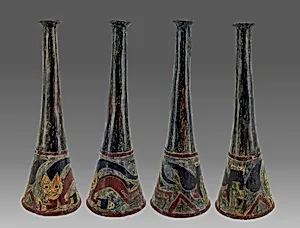
Medium
Ceramic, polychrome
Dimensions
12 × 4 × 4 1/8 in. (30.5 × 10.2 × 10.5 cm) Diameter (Of mouthpiece): 1 3/8 in. (3.5 cm)
Classification
Aerophone-Lip Vibrated
Culture & Period
Paracas · Pre-Columbian
Department
Musical Instruments
Museum
Metropolitan Museum of Art, New York, NY
Credit
Purchase, Amati Gifts, 2018
Accession Number
2018.75
Rights
Public Domain
Art Historical Context
This Paracas ceramic trumpet created between 300 and 200 BCE, offers rare glimpse into the musical traditions ancient Andean societies. Measuring roughly 12 inches long with a polychrome ceramic body, the instrument is classified as a lip-vibrated aerophone designed to produce sound through the vibration of the player’s lips against its mouthpiece. Its compact, elegant form and colorful painted surfaces reflect the sophisticated pottery techniques of the Paracas culture in what is Peru. As one of the earliest known examples of a playable wind instrument from the region, this trumpet highlights how music was woven into ritual, social, and possibly ceremonial life long before European contact. The use of multiple colors on fired demonstrates both technical skill and an aesthetic appreciation for visual harmony, qualities that would continue to influence later Andean art. Acquired by the Metropolitan Museum of Art in 2018, the piece allows today’s visitors to connect directly with a vibrant pre-Columbian world where art and sound worked together to express cultural identity.